Showing posts with label crime. Show all posts

The Vatican played for a sucker

Simplicio takes the bait

I am not, nor have I ever been, a fan of Cardinal Christoph Schönborn, Archbishop of Vienna. After this week, however, I may have to cut the clever beggar a bit of slack. It's possible—just possible—that he just out-maneuvered the slick operators of the Vatican with a slick operation of his own.

Schönborn probably fancies himself as one of the Church's papabili—the contenders for St. Peter's throne in the next papal conclave. He has devoted a lot of time to speaking out on the issues of the day, polishing his pastoral reputation, and even has a fan club devoted to him and his career. Unsurprisingly, given that the Catholic Church's stance on biological science necessarily embraces a form of theistic evolution (it wouldn't do to leave God out of the equation), intelligent design creationism has attracted a following among its prelates. Schönborn happily became an apologist for ID in 2005 when he published an editorial titled “Finding Design in Nature” in the New York Times. It was widely suspected that the Discovery Institute had ghost-written the cardinal's editorial, for the institute's fingerprints were all over it.

The editorial and Schönborn's subsequent book, Chance or Purpose?, were part of a campaign to walk the Church back from the earlier statement of John Paul II that evolution was “more than a hypothesis.” Inconvenient, that. Embracing evolution as scientific fact is more than conservative Catholics can stomach. As they are in the ascendant in Church ranks, Schönborn and his rivals seek ways to garner their support. Intelligent design offers them a refuge from godless evolution, so they shout their hosannas as they clutch it to their bosoms.

However, the Roman Catholic Church has a lot more on its plate than the hyped-up controversy over evolution versus creationism's flavor of the week. The ongoing scandal of child-molesting priests and the Church's weak response to it is a problem that doesn't seem to be going away. While Church apologists can point to other offenders and yell, “Look over there!”, most people don't fall for it. When a self-appointed arbiter of morality is caught cheating, the blatant hypocrisy is an irresistible media attraction.

Here Cardinal Schönborn has staked out the high ground, distinguishing himself from his head-in-the-sand colleagues. European Catholics (and others) have given Schönborn a lot of credit for his vigorous pursuit of justice for the victims of clerical child abuse and sanctions against the perpetrators and those who abet them. He recently criticized his colleague, Cardinal Angelo Sodano, for the latter's Easter Sunday homily, which contained a sentence addressed to the pope: “The people of God are with you and do not allow themselves to be impressed by the petty gossip of the moment.”

The remark was widely interpreted as dismissing criticisms of the pope's conduct of child-abuse allegations within the Church. Schönborn dared to suggest that Sodano's words were ill-chosen. The Austrian Kathpress reported that Schönborn claimed that Sodano had done “massive harm” to victims of clerical abuse by dismissing as “petty gossip” the criticisms of the Church for not acting more vigorously to rectify matters. “The days of cover-up are over,” Schönborn said.

Whereupon the Vatican summoned Schönborn to Rome so that he could apologize in person to Benedict XVI for the terrible things the cardinal had said. You see, Sodano had been effectively quoting the pope himself when he borrowed the “petty gossip” phrase for his Easter homily. In a Palm Sunday address, Benedict had similarly denounced criticisms as gossip. The Vatican issued a statement in defense of Sodano that made the point that he was following the pope's lead. Sodano's remark “was taken literally from the pontifical homily of Palm Sunday and referred to the ‘courage that does not let itself be intimidated by the gossip of prevalent opinions.’”

Schönborn had effectively stuck his thumb in the pope's eye. It was therefore necessary to treat the world to the spectacle of the Austrian cardinal abasing himself before Benedict and begging for the pope's forgiveness. The cardinal was forced to “clarify” his remarks, lest they be taken as critical of the Holy Father. Schönborn did not disappoint.

One could be forgiven for assuming that this public censure means that Schönborn is now spoiled goods, his dreams of the papacy irrevocably beyond his reach. But I suspect such a conclusion is premature. In fact, I suspect Schönborn knew exactly what he was doing and was not at all surprised by the reaction. I could be wrong, of course, but the Roman church is a kind of meritocracy in which only the most subtle campaigners and manipulators rise to the top.

It is almost inconceivable that Cardinal Schönborn did not know the content of the pope's Palm Sunday homily. Therefore he must have recognized the antecedents of Cardinal Sodano's Easter diatribe. Nevertheless, Schönborn sought out the Austrian press and gave them some acerbic comments. I wonder: Was he thinking of Galileo when he did that?

Galileo is the Church's most famous victim, forced to abjure belief in a heliocentric solar system and confined to house arrest for the last years of his life. The Church had permitted Galileo to treat heliocentrism as an amusing hypothesis, but not to teach it as reality. He went too far—in the opinion of the Church fathers—when he published his Dialogue Concerning the Two Chief World Systems. The three-cornered dialogue features Salviati, who presents the Copernican world view; Sagredo, who is initially neutral, waiting to be persuaded by argument and evidence; and Simplicio, defender of Ptolemy's geocentric system. As penned by Galileo, the debate is a rout. The simple Simplicio is humiliated and wise Sagredo throws in with Salviati.

It was rather unfortunate that, in the course of the dialogue, Simplicio gives voice to arguments that were favored by Pope Urban VIII. The pontiff was not amused to discover that Galileo was putting his words in the simpleton's mouth. Bad things immediately followed.

I don't want to over-extend the parallel, but Schönborn is a clever rascal. These days, you can't become a cardinal unless you're a survivor in the Vatican's internal politics. (In the old days, you just had to be one of the pope's “nephews,” born of one of his mistresses.) By placing himself in mild opposition to the pope, and receiving a disproportionate dressing-down, Schönborn is now in an interesting position. Benedict XVI is an old man (83 last April) and was elected as a transitional pope after a very lengthy papacy. There is no clear choice for his successor and no one stands out from the crowd. If Benedict does not manage to resolve the continuing scandal of clerical sex-abuse of children, he may be deemed a failure in the eyes of the world and—even more important in terms of papal succession—in the bloodshot eyes of the red-robed cardinals..

That would make the College of Cardinals nervous indeed about electing a successor with too many ties to the old order. While fidgeting about, waiting for some manifestation of the Holy Spirit to whisper the next pope's name in their ears, the cardinals might very well look to someone clearly separated from the policies of Benedict XVI.

Now who could that be?

Read more...

The unpardonable sin

An insanity plea might work

The collective irrationality of today's right-wing pundits makes it relatively easy to be a comparatively sane conservative. So why are there so few of the latter? I guess there's nothing like the freedom-loving right-wing extremists for enforcing absolute adherence to a rigorous standard. San Francisco Chronicle columnist Debra Saunders tries her best to be an independent voice, but often fails. And, unfortunately, her occasional successes have problems of their own.

Last week, for example, Saunders penned a ridiculous column with whose premise I paradoxically agree. Does that sound weird enough for you? Allow me to explain.

On November 24, 2009, the Chronicle published a Saunders column that took President Obama to task for his stingy application of his pardoning powers. Here she shakes an admonitory finger at the nation's chief executive:

Obama hasn't pardoned a single ex-offender, even though about 1,200 people have asked for pardons because they have turned their lives around, expressed remorse for their crimes and now want to wipe the criminal slate clean of long-past offenses for which they paid the penalty.
That's right. Debra Saunders is a bleeding-heart conservative. It's one of her favorite ways to step to a different drummer while the rest of the right-wing crowd march in lockstep to the tempo of the teabaggers. Her particular concern is the number of nonviolent offenders who are serving disproportionately long sentences for minor crimes. The nation's draconian anti-drug laws have jammed the jails and prisons with people who scarcely deserve to be called criminals. I agree with Saunders that we have an unhealthy penchant for incarceration in this country (USA! Number One!) and that the presidential pardon could help to right some of the injustices.
When you think about it, the pardon petition is the rare Washington exercise that encourages politically unconnected people to petition their president for relief. But like Bush and Clinton before him, Obama seems to be hoarding this power. It's as if Team Obama sees justice as perk, not an equal right.
Yes, indeed. President Obama should get busy commuting some sentences and righting some wrongs. And the friends and political allies of Debra Saunders will rally around him and praise him for his devotion to the principles of justice and fairness.

Yeah. Right.

Now Debra Saunders did not claim that people would cheer such presidential action. To be fair, she actually said, “This is where a number of readers no doubt are talking back to the paper and saying that it's just fine with them if Obama keeps career criminals behind bars, thank you very much.”

Ha, ha, Debra! You jolly joker! She could have been just a little more honest and said something like, “We conservatives would then have Obama for lunch, crunch his bones with our teeth, and spit out the splinters!” The language is just a shade too florid for the gentle Saunders, but it captures the sense of what we know would occur in reality. Right-wing pundits would “Willie Horton” the president in a nanosecond. Teabaggers would demand his impeachment for various imagined crimes (as they are already doing).

The cherry on the Saunders silly sundae was delivered this week, when Debra returned to the topic of executive clemency. On December 3, 2009, the Chronicle ran her column on Mike Huckabee, a candidate in 2008 for the Republican nomination for president and the former governor of Arkansas. Huckabee, you see, was a soft touch for criminals who had “found Jesus” and was quick to give them “Get Out of Jail Free” cards. One of those pardoned criminals is the late Maurice Clemmons, the man accused of ambushing and killing four policemen in Washington state. No doubt Saunders was wishing she had not written her earlier column on the eve of the Clemmons crime spree.
I am especially angry at Huckabee because I support the pardon system. With so many nonviolent, first-time drug offenders serving long federal sentences, there should be more—not zero—sentence commutations from the Obama White House.
I say again that I agree with Saunders in principle, but I also would like to point out a couple of things that she utterly fails to address, stripping her argument of any realistic context:

First, the right wing in American politics is responsible for debasing the level of discourse in this country to such a degree that any measured approach to executive pardons is impossible. There is no doubt—none at all—that every single presidential pardon would be the occasion of screaming, braying, chest-pounding, rending of garments, frothing at the mouth, and scattering of ashes. These are the people who routinely accuse their political opponents of treason, dishonesty, and conspiratorial plans to destroy the nation. Civil discourse is entirely beyond them.

Second, Huckabee is merely one example of the power of clot-minded religion to turn people into credulous simpletons. The Republican Party, in particular, is infested with candidates who think the world was created in six days less than 10,000 years ago or pander to those who do. Huckabee was a member in good standing of this Dark Age fraternity. While his remaining political aspirations, if any, are now dead and gone (and unlikely to experience resurrection), there are still plenty of politicians who give religious dogma priority over rational thought. With Sarah Palin on the scene, backward thinking still has a future.

Pardon me for retching.

Read more...

How stupid are conservatives?

Really, really, really stupid

Conservative acquaintances sometimes accuse me of not listening to both sides of the political arguments of the day. I've heard this from my parents and from the token Republicans who are permitted to sit in on my Friday lunch group (which is mostly a bastion of hardcore moderates and liberals). The reality is rather different. I actually listen to much more right-wing talk radio than is good for my digestion. It's like a bad habit, but one likes to know what the opposition is up to (or down to).

Rabbi Daniel Lapin is the Sunday afternoon talk-show host on KSFO who puts the Jew in Judeo-Christian. Given KSFO's target demographic, most of Lapin's listeners are probably right-wing Christians who know he is doomed to burn in hell for failing to embrace humanity's Lord and Savior, but he's conservative enough to be tolerated in this life. Of course, Lapin isn't the only Jew who has turned to the dark side of America's political force. One of his fellow travelers called in during last Sunday's gabfest.

Lapin greeted Hannah cheerfully and she wished him a happy Passover. Then she added her two cents' worth to the theme of the day: differences between liberals and conservatives.

Hannah: As far as your topic, well, it might sound simplistic to you, and you're probably going to say that I have a one-track mind, but I blame everything on the liberals. I really do. I think if Sigmund Freud lived today, he would be a liberal.

Lapin: You're right about that. No question. He was and is and always will be a liberal.

Hannah: Yeah. And the problem is that this whole science of—if you can call it a science—of psychiatry, I think is lot to blame for this because instead of just punishing somebody who goes and killing people, they look for reasons. I mean, I'm not interested in the reason. I mean, maybe the guy is miserable, but that's no reason to kill somebody.

Lapin: That's right. And that's how I started this segment, this discussion. Stop inquiring as to why the Binghamton murderer did it. It's irrelevant.
Wow. Just wow.

Who cares what the reasons are for mass murder? It's possible that such knowledge might enable us to reduce the number of occurrences of these violent crimes, but seeking answers is so ..., well, gay, right? Only sissies and liberals (but I repeat myself, of course) want to understand things. Conservatives are willing to wallow in ignorance as long as they get a chance to serve on the firing squad, pull the lanyard on the guillotine, take a swing with the axe, release the trap door on the gallows, or flip the switch on the electric chair. Somewhere along the line they heard that ignorance is bliss and decided to maximize their happiness.

Say, who owns the rights to the name of the Know Nothing Party? I know some people who could make good use of it.

Read more...

I beg your pardon?

Will Obama be 45?

Everyone is anticipating the swearing-in on Tuesday of Barack Obama as our 44th president. Three years ago, however, I considered the possibility that the person sworn in on January 20, 2009, would actually be our 45th. In speculating about the future, I hit some marks (Pelosi is speaker; Bush is hugely unpopular) and missed others (the Senate does not have a 50-50 split; the House did not aggressively investigate the Bush administration; Al Gore was not the Democratic candidate), but there are some things we may never know.

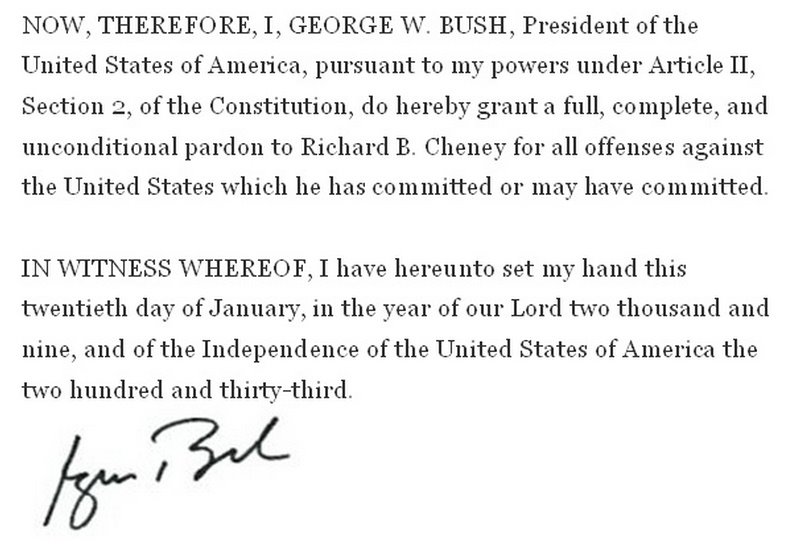
What if George Bush and Dick Cheney decided it would be good, as a precaution, to immunize themselves from criminal prosecution? You can read my original 2006 post for the entire scenario, but here are the key paragraphs:

The president had hoped that someone would say something uplifting on the occasion of his last day in office, but his guests were all business. It would have been difficult in any case to offer the customary platitudes about missions accomplished or goals achieved. The nation was eager to see him gone and his approval numbers had long languished in the low twenties, rivaling Nixon's just before his resignation. The disastrous 2006 elections had saddled him with a Democratic House of Representatives and nonstop congressional hearings on executive branch corruption had taken a toll. Articles of impeachment had not been voted, but scores of Bush administration officials had scrambled to secure immunity in return for their testimony. The American people seemed simultaneously disgusted and fascinated by the spectacle. The president had been disappointed in his hopes that they would soon be sated and lose interest. Instead the voters had decided that the 2006 results were a half-measure. They had used the 2008 election to increase Speaker Pelosi's margin in the House and broken the tie in the Senate, making Harry Reid the majority leader. Both the Democratic and Republican nominees for president had campaigned against the incumbent, the latter only slightly less overtly than the former.

The secretary of state was carrying a slender portfolio. She slipped a single sheet of paper out of it, stiff bond paper carrying the White House letterhead, and placed it on the desk before the president. He took up a pen and quickly signed it. “Here you go, Dick.”


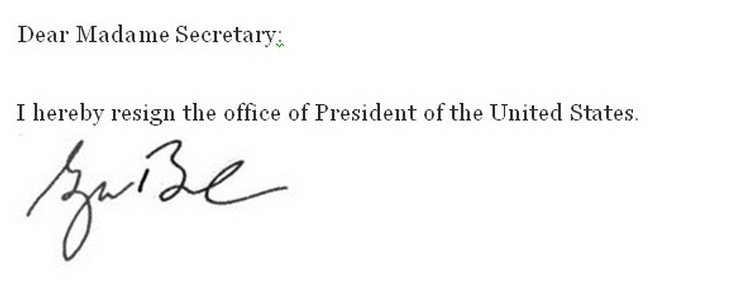
“Thank you, Mr. President.” The vice president accepted the proffered sheet of paper, folded it carefully, and slipped it into the inside pocket of his coat. The secretary of state pulled another sheet of paper from her portfolio and placed it before the president. George Bush stared at it for several seconds, then wielded his pen again.

“Thank you, Mr. President,” said the secretary of state, suddenly keenly aware that it was now just a courtesy title. She carefully placed the resignation letter back into her portfolio. Mrs. Cheney began to rummage in her large handbag and pulled out a Bible. With impeccable timing, a muffled rap on the door accompanied the entrance of Mr. Alito, the junior associate justice of the Supreme Court. The Court was precariously split down the middle and the president had been unable to fill the Stevens vacancy because the emboldened Democrats in the U.S. Senate had blocked his nominee. The Democratic president-elect would begin his term of office with a crucial Supreme Court appointment.

President No. 44

Justice Alito was wearing a business suit rather than judicial robes. He greeted the occupants of the Oval Office and they quickly arranged themselves, Cheney with his right hand lifted, his left hand on the Bible in his wife's hands, and Bush and Rice to one side. “Please repeat after me. I, Richard Cheney, do solemnly swear that I will faithfully execute the office of President of the United States, and will to the best of my ability, preserve, protect, and defend the Constitution of the United States.” The former vice president echoed the justice's words, ending his recitation with an emphatic, “So help me God!” The words were a traditional coda to the presidential oath of office, but they were not actually in the U.S. Constitution.

“Congratulations, Mr. President,” said Justice Alito, shaking Cheney's hand. The new president exchanged a quick kiss with the new first lady and then shook hands with his immediate predecessor and the secretary of state. “Okay,” he said. “Let's finish this.”

Secretary Rice dipped into her portfolio again. In addition to the presidential resignation letter, it contained her own previously signed presidential pardon and one other sheet of White House stationery. She placed it on the desk and President Cheney signed it. He handed the document to Bush, who stared at it until Rice suggested she take care of it for him. He gratefully handed his own presidential pardon to the secretary of state.

“Of course, it's not like we are really going to need that,” he said, trying to make light of it.

“It doesn't hurt to be safe, George,” said President Cheney. The former president's eyes widened at the use of his first name and he flinched as if struck. Bush opened his mouth as if to speak, then closed it again.
Think it couldn't happen? It all depends on Dick, doesn't it?

Read more...

Sexy Nude Celebrity Hot Female Celebrity