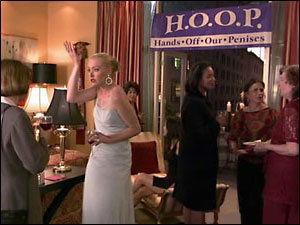
Back away from the penis!

The voters of the City and County of San Francisco have placed a proposed circumcision ban on the November general election ballot. It would make it illegal to remove the foreskins of minors without a showing of medical necessity. It would not, however, have any impact on adult males who wish to have their penises clipped. The rationale is simple: Baby boys cannot give informed consent.
The reaction to the ballot initiative is unsurprisingly shrill. Here's the opening paragraph of an opinion piece by Rabbi Gil Leeds, which was published on May 20, 2011, in the San Francisco Chronicle:
Freedom of religion, enshrined over two centuries ago by the Constitution and the Bill of Rights, is now subject to a vote with the certification in San Francisco of the referendum on circumcision for the November ballot. The vote will empower a secular majority to impose its will, and ban one of the oldest religious traditions known to humanity. When religious belief and practice become subject to vote by the majority of a city council, government agency or referendum, it endangers all of our rights and freedoms.The proposed legislation contains no religious exemptions, so the traditional Jewish bris ceremony could no longer be practiced in San Francisco if the circumcision ban were enacted. That is why Leeds frames it as an attack on religious freedom. This got me to thinking.
What does religious tradition protect? How far can it go? Leeds correctly points out that male circumcision is a very old religious practice, so it definitely fits under the mantle of tradition, at least for Jews. It's also long been considered normative for American males, quite apart from religious practice. As a culture, we're inured to it and most people take it in stride as expected and unexceptional. While a few circumcised men have complained about having been robbed of their foreskins, most clipped males appear to be content with their condition. It hasn't been a major controversy.
On the other hand, female circumcision is widely condemned as genital mutilation and is against the law in the United States and the target of an international campaign to suppress it. In fact, “circumcision” is rather a misnomer for the procedure(s) applied to young girls in those cultures that practice it. The term comprises a broad range of actions, from reduction or amputation of the clitoris to wholesale excision of the labia. The most extreme form involves infibulation, stitching up the vaginal passage to make it smaller and to ensure the virginity of the victim; the procedure may be reversed when she is properly married off.
Female “circumcision” is an ancient practice that is done in secret in places like the United Kingdom and the United States, nations in which it is legally banned. Members of immigrant families may go to great lengths to ensure that their daughters are genitally cut so that future suitors may be assured of their respectability. The UK and US make no allowance for the ancient tradition, deeming it a violation of basic human rights and labeling it as “female genital mutilation.”
The sponsors of the anti-circumcision measure in San Francisco took a page from the international campaign to protect girls when they titled their proposal as the “San Francisco Male Genital Mutilation” initiative. The city attorney toned that down to the “Male Circumcision” measure, but Leeds the mohel is unmollified:
The proposal's backers are trying to deceive the voters by labeling it a “ban on genital mutilation.” Honesty would have demanded they called it a ban on circumcision. By using such a toxic term as mutilation, they hope to garner support from an unsuspecting public.My question is this: How is cutting off part of a little boy's penis not a “genital mutilation”? Because our society is inured to it? Because some people practice it as a religious rite? Because it's not as grotesque as the female version? Because there are some supposed health benefits?
What if a religious sect insisted it was their right to practice infibulation on their infant daughters? Would we be violating their freedom of religion if we refused to allow it? (We have clearly already decided that question, haven't we?)
Circumcised males can take comfort in being in the majority and having undergone a procedure that has long been considered unremarkable and of which they haven't the slightest recollection. They understandably react negatively at being told that they were “mutilated” at birth. It's a charged term. At the same time, the uncircumcised minority cringe at the thought of having their foreskins lopped off and marvel that their clipped brethren can be so complacent about having lost theirs. It's what you're used to, I suppose.
The religious aspect doesn't faze people for whom religion is just a superstitious practice that gets more respect than it deserves. Rabbi Leeds hung his argument on the right of people to clip their sons' penises in honor of a supposed covenant with Yahweh. After his article appeared in the Chronicle, San Francisco's archbishop weighed in with an angry letter in support of the rabbi:
I would like to add my “Amen” to the op-ed piece by Rabbi Gil Leeds, “Circumcision ignores our basic religious freedom” (May 20).I don't know that you're helping, George. Protecting the health and hygiene of one's children these days would seem to include keeping them away from Catholic churches. May I suggest that you—ahem!—keep your hands off their penises?
The proposed ban on circumcision represents an unconscionable violation of the sanctuaries of faith and family by the government of San Francisco. Although the issue does not concern Christians directly, as a religious leader I can only view with alarm the prospect that this misguided initiative would make it illegal for Jews and Muslims who practice their religion to live in San Francisco—for that is what the passage of such a law would mean.
Apart from the religious aspect, the citizens of San Francisco should be outraged at the prospect of city government dictating to parents in such a sensitive matter regarding the health and hygiene of their children.
George Niederauer, Archbishop of San Francisco