Showing posts with label religion. Show all posts

Wolf in priest's clothing

Hypocrisy 101

One of the buttons on my car radio is set to the local Catholic station. I punch it occasionally to see what my former co-religionists are up to. There aren't many surprises these days. Catholic radio is little more than an extension of the nation's extreme political right, an environment in which someone like Alan Keyes is considered a credible and worthwhile guest. It's convenient to sample the broadcasts in small doses until I reach the limits of my endurance and punch the news-radio or classical-music button.

One of Catholic radio's most recognizable voices belongs to Father John Corapi. His acidic baritone drips with contempt as he excoriates those who are supposedly corrupting modern society and exhorts his listeners to take up cudgels in defense of morality, purity, virtue, and motherhood. Corapi lays it on pretty thick. He likes to beat his breast about the sins of his youth and to offer himself as an example of overcoming one's personal demons. If he could do it, so can you! Fr. Corapi has no patience with lame excuses for not taking up one's cross and joining the church militant in the ongoing culture war.

It happens, however, that I am wrong to use the present tense. Corapi disappeared from Catholic radio during the spring and has now withdrawn from public ministry. His religious order has deemed him unfit to discharge priestly duties. The Society of Our Lady of the Most Holy Trinity—which uses the acronym SOLT—was not restrained in its rebuke of its wayward son:
July 5, 2011

FOR IMMEDIATE RELEASE

From: Rev. Gerard Sheehan, solt Regional Priest Servant Society of Our Lady of the Most Holy Trinity Robstown, Texas

Fr. John A. Corapi submitted his resignation from the Society of Our Lady of the Most Holy Trinity (“SOLT”) early in June. SOLT is a Society of Apostolic Life of Diocesan Right with its regional office in Robstown, Texas.

While SOLT does not typically comment publicly on personnel matters, it recognizes that Fr. John Corapi, through his ministry, has inspired thousands of faithful Catholics, many of whom continue to express their support of him. SOLT also recognizes that Fr. Corapi is now misleading these individuals through his false statements and characterizations. It is for these Catholics that SOLT, by means of this announcement, seeks to set the record straight.

A woman, well known to Fr. John Corapi, mailed SOLT a signed letter detailing allegations of Fr. Corapi's sexual activity with adult women, abuse of alcohol and drugs, improper sacramental practices, violation of his promise of poverty, and other wrongdoing.

After receiving the allegation, SOLT formed a three person fact-finding team to ensure that it handled this matter in accordance with canonical norms. The team included a priest-canonist, a psychiatrist, and a lawyer. Two were members of religious orders, and one was a lay Catholic. Two were men, and one was a woman. All three have national reputations and substantial experience in ecclesiastical processes related to priest disciplinary issues.

As the Society was engaging this team, Fr. Corapi filed a civil lawsuit against his principal accuser. He contended that she had defamed him and breached her contract. The contract, according to Corapi's lawsuit, contained a provision binding the woman to silence about him. He offered the woman $100,000 to enter this agreement.

SOLT's fact-finding team subsequently learned that Fr. Corapi may have negotiated contracts with other key witnesses that precluded them from speaking with SOLT's fact-finding team. Many of these witnesses likely had key information about the accusations being investigated and declined to answer questions and provide documents.

When the fact-finding team asked Fr. Corapi to dismiss the lawsuit, to forbear from foreclosing his mortgage, and to release her and other individuals from their contractual obligations to remain silent about him, he refused to do so and, through his canonical advocate, stated: “It is not possible for Father Corapi to answer the Commission's questions at this time.”

SOLT's fact-finding team has acquired information from Fr. Corapi's e-mails, various witnesses, and public sources that, together, state that, during his years of public ministry:

He did have sexual relations and years of cohabitation (in California and Montana) with a woman known to him, when the relationship began, as a prostitute; He repeatedly abused alcohol and drugs; He has recently engaged in sexting activity with one or more women in Montana; He holds legal title to over $1 million in real estate, numerous luxury vehicles, motorcycles, an ATV, a boat dock, and several motor boats, which is a serious violation of his promise of poverty as a perpetually professed member of the Society.

SOLT has contemporaneously with the issuance of this press release directed Fr. John Corapi, under obedience, to return home to the Society’s regional office and take up residence there. It has also ordered him, again under obedience, to dismiss the lawsuit he has filed against his accuser.

SOLT's prior direction to Fr. John Corapi not to engage in any preaching or teaching, the celebration of the sacraments or other public ministry continues. Catholics should understand that SOLT does not consider Fr. John Corapi as fit for ministry.
Corapi's resignation from SOLT effectively terminates the order's investigation into its former member. Unless civil authorities take an interest in possible criminal behavior, the nature of which is unclear, Corapi can pursue his lawsuit against his accuser without interference from SOLT or any ecclesiastical body.

At this point, Corapi is still a priest, although one without a formal affiliation with any religious order. Under those circumstances, it is difficult for him to function as a cleric within the Church's hierarchical structure. He insists, however, that he remains a faithful Catholic and has issued a string of statements and denials of wrongdoing on a new blog, where he styles himself “the Black Sheep Dog” of the Church. Demonstrating his possession of a tin ear, he offers a Clintonesque denial of the charge of sexual impropriety:
I have never had any promiscuous or even inappropriate relations with her. Never.
Corapi also assures visitors to his blog that he still sees himself as having a vocation:
Wherever justice is subverted in the name of expediency, or through abuse of authority truly freedom-loving people should raise their voices against it. There is no shortage of such causes today. In the future the Black Sheep Dog will be doing what he can to sound the alarm and exhort the troops.
Woof.

Read more...

No sense of proportion

Large and small insanities

As Douglas Adams has observed, the universe is so mind-bogglingly big that a sense of proportion can be a dangerous thing to have. That is, at least, if you want to maintain your equanimity and sense of self-worth.

Nevertheless, the absence of any sense of proportion appears to be one of society's major ills. It manifests itself in various forms of innumerate inanity and scientific delusion. I have three very different examples in mind, the toxic impact of which should be readily apparent to any minimally rational reader. Today I'll present the first one, which is a delightful mix of religion and pseudoscience.

Playing center

Lyndon Johnson is supposed to have cruelly quipped that Gerald Ford spent too much time playing center on his football team, looking at the world upside-down from between his legs. I wonder whether Robert Sungenis filled the same position on his high school's team. Whatever the case may be, he ended up as a dedicated exponent of the theory that he is the center of the universe.

Forgive me. I overstate the situation just a little. Sungenis is actually a geocentrist rather than an egocentrist (although I suppose it's possible that he could be both). An ultramontane Catholic apologist who is far outside the mainstream of Catholic thought, Sungenis is a Bible literalist who believes in young-earth creationism and argues that Joshua couldn't have ordered the sun to stop in the sky (Joshua 10:12-13) unless it circled the earth—and not the other way around. Logical, right?

Sungenis is considered an embarrassment to the Catholic hierarchy even though he is trying to defend its old accusations against heliocentrist Galileo Galilei. However, his diocesan bishop has deemed some of his essays anti-Semitic and has ordered him to stop writing such material. You'd think the Church fathers would be grateful!

I have encountered Sungenis before. Any Google search on Catholic apologetics brings up his “Catholic Apologetics International” website, although it has since been renamed the “Bellarmine Theological Forum.” I was reminded of his rabid geocentrism upon being directed to an amusing post on The Greenbelt, where The Ridger gently eviscerates the campaign by Sungenis to discredit Galileo. As she points out, “When Ken Ham finds you too wacky, you are definitely in need of help.”

To get a sense of how ridiculous it is to think that the entire universe spins about a fixed earth, consider the simple case of Neptune. The distance between Earth and Neptune averages 30 astronomical units—that is, thirty times the mean distance of the earth from the sun. Assuming that Neptune's supposed path about the earth is approximately a circle, we compute the circumference of a circle with a radius of 30 AU to obtain a distance of 60π AU. This is the distance that Neptune supposedly travels in a single 24-hour period as it wheels about the earth. So how fast does Neptune have to travel to complete that circuit in the allotted time? Since an astronomical unit is approximately 93 million miles, a little calculator work yields 730 million miles per hour. If we divide by 3600 (the number of seconds in an hour) to convert this speed to miles per second, we get a little over 200 thousand miles per second for Neptune's speed.

Oops. The speed of light is only about 186,000 miles per second. Unless Neptune has warp drive, it can't possibly be traveling faster than the speed of light.

Please note that we were discussing the simple case of a relatively close planet—one that shares the same solar system as the earth. Imagine how much more ridiculous the results would be if we merely extended them to the nearest star, approximately four light-years away. Or the Andromeda galaxy, about a million light-years away. (The folks in Andromeda must be as dizzy as hell!)

Of course, this refutation of geocentricity assumes that Einstein was right. I'm sure that Sungenis is prepared to contradict Einstein in his discussion of “Jewish science.” You know, perhaps we should revisit the “egocentric” issue in his case.

Read more...

Religion-crippled reason

I guess God hates logic

Noah Hutchings is the superannuated leader of the Southwest Radio Church. His radio broadcasts are replete with numerological arguments (God the Master Mathematician) for various wacky Christian dogmas and earnest warnings about the imminent apocalypse. Hutchings isn't quite crazy enough to set dates in the manner of Harold Camping, but he demonstrates his lack of basic reasoning skills in virtually every radio program.

The July 6 installment of Bible in the News took President Obama to task for having issued a proclamation that designated June as “Lesbian, Gay, Bisexual, and Transgender Pride Month.” Hutchings quoted a line that was actually from Obama's 2009 declaration: “I am proud to be the first President to appoint openly LGBT candidates to Senate-confirmed positions.... These individuals embody the best qualities we seek in public servants.”

Hutchings draws the obvious conclusion from the president's statement: “In other words, President Obama says that homosexuals are better than heterosexuals.”

Yeah, I can see that. In a world where “equal rights” immediately equate to “special rights” when certain minorities are concerned, it makes complete sense that praising the qualifications of gay individuals is tantamount to proclaiming them better than straight people. If your brain is sufficiently god-rotted, you can follow this line of reasoning, too.

Hutchings went on to say, “ He has indeed appointed, according to reports, over 150 to high government positions—many more than heterosexuals.” Oh, yes. The president has fewer than 300 government positions to fill by appointment, so 150 LGBT appointments constitute a clear majority of Obama's administration.

I think the statements by Mr. Hutchings are as stupid as any I've ever heard. Perhaps he will now declare that I am therefore claiming he is more stupid than anyone else. ... Damn. This time he might be right!

Read more...

Cutting remarks

Cosmetic surgery?

Remember the episode of Seinfeld titled “The Bris”? Jerry gets quizzed by Elaine:
Elaine: Hey, Jerry, you ever seen one?
Jerry: Oh, you mean that wasn't ... uh?
Elaine: Yeah.
Jerry: No. Have you?
Elaine: Yeah.
Jerry: What'd you think?
Elaine: [wrinkles her nose] It had no face, no personality. It was like a Martian. But hey, you know, that's me.
I was reminded of this when Debra Saunders of the San Francisco Chronicle decided to have some fun with circumcision in her opinion column this morning:
The ballot measure bills itself as a ban on “forced genital cutting” and “mutilation.” Clearly the authors want to confuse voters by equating male circumcision to female genital mutilation, the barbaric, unsanitary butchering of a young girl's private parts in a procedure that has been known to leave girls severely infected and in pain.
Saunders is echoing the remarks of Rabbi Gil Leeds, who similarly complained that “mutilation” is a misnomer. I tend to disagree, since the permanent amputation of part of the penis should not be treated as a trivial matter, even if the results aren't on the same level as the brutality of so-called “female circumcision.”

Saunders tips her hand even while trying to be even-handed. She cites a pediatrician while ostensibly presenting both sides:
[Dr. Erica Goldman] informs parents of the pluses—reduced chances of urinary tract infection and sexually transmitted diseases—as well as the risks—it's a permanent cosmetic change.
Oy! The “risk” of circumcision is that it's a cosmetic change? It's not a direct quotation, so we can't simply blame Dr. Goldman for this conclusion. It's what Saunders picked out as the key item, ignoring all other factors. (Should we tell circumcised boys that the lack of a foreskin is why they need lube? Is Johnson & Johnson—manufacturers of K-Y Jelly—behind the push for more male circumcisions? This calls for an investigation!)

I snorted when I saw Saunders using the words “cosmetic change,” but I guffawed when I read her peroration. Like the dutiful right-wing columnist that she is, Debra has to complain about “nanny state” legislation and frame the anti-circumcision measure in those terms, slipping in an allusion to the city's ban on toy giveaways with unhealthy fast food. It's a poor fit:
A busybody law? Check. Does it address a problem most folks did not know existed? Check. Pun opportunities? Oh, yeah. First they came for the Chicken McNuggets, then they came for my son's ...
No, no, no, Debra. You're missing the point entirely. The ballot initiative says they have to leave your son's nuggets alone!

Read more...

Back away from the penis!

San Francisco on the cutting edge

The voters of the City and County of San Francisco have placed a proposed circumcision ban on the November general election ballot. It would make it illegal to remove the foreskins of minors without a showing of medical necessity. It would not, however, have any impact on adult males who wish to have their penises clipped. The rationale is simple: Baby boys cannot give informed consent.

The reaction to the ballot initiative is unsurprisingly shrill. Here's the opening paragraph of an opinion piece by Rabbi Gil Leeds, which was published on May 20, 2011, in the San Francisco Chronicle:
Freedom of religion, enshrined over two centuries ago by the Constitution and the Bill of Rights, is now subject to a vote with the certification in San Francisco of the referendum on circumcision for the November ballot. The vote will empower a secular majority to impose its will, and ban one of the oldest religious traditions known to humanity. When religious belief and practice become subject to vote by the majority of a city council, government agency or referendum, it endangers all of our rights and freedoms.
The proposed legislation contains no religious exemptions, so the traditional Jewish bris ceremony could no longer be practiced in San Francisco if the circumcision ban were enacted. That is why Leeds frames it as an attack on religious freedom. This got me to thinking.

What does religious tradition protect? How far can it go? Leeds correctly points out that male circumcision is a very old religious practice, so it definitely fits under the mantle of tradition, at least for Jews. It's also long been considered normative for American males, quite apart from religious practice. As a culture, we're inured to it and most people take it in stride as expected and unexceptional. While a few circumcised men have complained about having been robbed of their foreskins, most clipped males appear to be content with their condition. It hasn't been a major controversy.

On the other hand, female circumcision is widely condemned as genital mutilation and is against the law in the United States and the target of an international campaign to suppress it. In fact, “circumcision” is rather a misnomer for the procedure(s) applied to young girls in those cultures that practice it. The term comprises a broad range of actions, from reduction or amputation of the clitoris to wholesale excision of the labia. The most extreme form involves infibulation, stitching up the vaginal passage to make it smaller and to ensure the virginity of the victim; the procedure may be reversed when she is properly married off.

Female “circumcision” is an ancient practice that is done in secret in places like the United Kingdom and the United States, nations in which it is legally banned. Members of immigrant families may go to great lengths to ensure that their daughters are genitally cut so that future suitors may be assured of their respectability. The UK and US make no allowance for the ancient tradition, deeming it a violation of basic human rights and labeling it as “female genital mutilation.”

The sponsors of the anti-circumcision measure in San Francisco took a page from the international campaign to protect girls when they titled their proposal as the “San Francisco Male Genital Mutilation” initiative. The city attorney toned that down to the “Male Circumcision” measure, but Leeds the mohel is unmollified:
The proposal's backers are trying to deceive the voters by labeling it a “ban on genital mutilation.” Honesty would have demanded they called it a ban on circumcision. By using such a toxic term as mutilation, they hope to garner support from an unsuspecting public.
My question is this: How is cutting off part of a little boy's penis not a “genital mutilation”? Because our society is inured to it? Because some people practice it as a religious rite? Because it's not as grotesque as the female version? Because there are some supposed health benefits?

What if a religious sect insisted it was their right to practice infibulation on their infant daughters? Would we be violating their freedom of religion if we refused to allow it? (We have clearly already decided that question, haven't we?)

Circumcised males can take comfort in being in the majority and having undergone a procedure that has long been considered unremarkable and of which they haven't the slightest recollection. They understandably react negatively at being told that they were “mutilated” at birth. It's a charged term. At the same time, the uncircumcised minority cringe at the thought of having their foreskins lopped off and marvel that their clipped brethren can be so complacent about having lost theirs. It's what you're used to, I suppose.

The religious aspect doesn't faze people for whom religion is just a superstitious practice that gets more respect than it deserves. Rabbi Leeds hung his argument on the right of people to clip their sons' penises in honor of a supposed covenant with Yahweh. After his article appeared in the Chronicle, San Francisco's archbishop weighed in with an angry letter in support of the rabbi:
I would like to add my “Amen” to the op-ed piece by Rabbi Gil Leeds, “Circumcision ignores our basic religious freedom” (May 20).

The proposed ban on circumcision represents an unconscionable violation of the sanctuaries of faith and family by the government of San Francisco. Although the issue does not concern Christians directly, as a religious leader I can only view with alarm the prospect that this misguided initiative would make it illegal for Jews and Muslims who practice their religion to live in San Francisco—for that is what the passage of such a law would mean.

Apart from the religious aspect, the citizens of San Francisco should be outraged at the prospect of city government dictating to parents in such a sensitive matter regarding the health and hygiene of their children.

George Niederauer, Archbishop of San Francisco
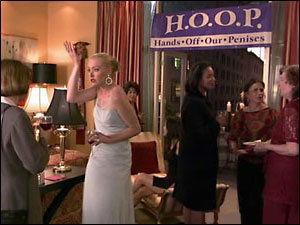
I don't know that you're helping, George. Protecting the health and hygiene of one's children these days would seem to include keeping them away from Catholic churches. May I suggest that you—ahem!—keep your hands off their penises?

Read more...

To your scattered bodies go

You complete me

In one of Innumeracy's more notorious examples, John Allen Paulos provides a back-of-the-envelope calculation for the probability that you just inhaled a molecule from Julius Caesar's dying breath: “The surprising answer is that, with probability better than 99 percent, you did just inhale such a molecule.” (If you gasped at learning that, the probability probably went up.)

It immediately follows that your body has an exceedingly high probability of containing atoms that were once part of Caesar's body. And atoms from Brutus, too, of course. While Carl Sagan liked to point out that we are made of star stuff, one must not forget that we are made of recycled star stuff.

This has amusing implications for the devout Christian, since all of humanity is supposed to stand before Jesus for final judgment in reconstituted physical bodies. When Jesus says the magic words to assemble all of the dearly departed (including those he conveniently killed by destroying the world), who gets dibs on all of those “previously owned” atoms?

Fairness suggests they should go to the original owners. Therefore Adam and Eve would appear before the throne with intact resurrection bodies (assuming for the moment for the sake of argument that the Edenic couple were real people), but subsequent generations would be increasingly challenged as one progressed along the family tree. I daresay that the most recent revenants would be likely to present a most ghastly and moth-eaten aspect. (God may want to secure the services of George Romero to act as producer-director of the Last Judgment.)

Fortunately for all of us, there are serious scholars available to answer the questions we might have about such significant matters. Such was the case in a recent installment of “Catholic Answers,” the radio call-in program that broadcasts throughout California on the stations owned by Immaculate Heart Radio. A concerned listener wanted to know what would happen on the day of judgment to people whose bodies had not been buried intact. For example, what about organ donors? Could you end up standing before Jesus with a hole in your chest if your heart had gone to another?

Father Tad Pacholczyk, director of education for the National Catholic Bioethics Center, was equal to the task:
It seems like there might be some concerns that would come in the wake of the decision to donate a lot of organs and then sort of the whole question at the resurrection whose body will it be and so on? These are in a sense mysterious questions that we don't have all the answers to, but we know, for example, when people end up having their bodies basically destroyed—and all of us will, I mean, if we're buried in the ground. Eventually, you know, our bodies decompose completely and there's nothing left of them. And some of the elements from our bodies might be taken up into plants that grow above the grave and then those plants would be eaten by animals and then those animals would be eaten by humans. So some of our materials may even be recycled, so to speak, into other people's bodies. None of this is going to pose a problem for the infinite power of God. These are the kinds of things that, yeah, we don't know how he's going to do it, but do know that he is going to do it.

I sometimes also mention the example of St. Maxmilian Kolbe, who died in Auschwitz and his body was put into the crematoria and his ashes went up and were spread all over half of Poland. And when he resurrects, the Lord will be able to, you know, bring his entire body back through the power of God.
Okay. I guess that's all settled now. It's magic.

I knew there had to be a good answer.

Read more...

Countdown to nothing

Lessons unlearned

In light of the imminent “end of the world,” as predicted by the venerable Harold Camping of Family Radio, lots of people are aware that Mr. Camping is trying to redeem himself (there may be a joke in there) in the aftermath of his failed end-of-the-world prediction in 1994. What you may not know is that Camping got it wrong twice with that earlier prediction. He confidently proclaimed that his mathematical computations proved Jesus would return on September 6, 1994. On September 7, an entirely intact but chagrined Camping reported he had made a mistake (duh!) and was checking his math. (The “mathematical” computations always crack me up. It's just random-ass arithmetic with strained interpretations of numbers and phrases from the Bible.) The penitent prophet banged some more keys on his calculator and revised his prediction: Now the world would end between September 15 and 17!

On September 18, the world had another good chuckle and Harold Camping passed into a period of relatively benign neglect. Until he came out with his prediction about May 21, 2011, the world was content to ignore him. He and his minions have insisted on our renewed attention, however, plastering the countryside with expensive billboards and distributing literature about Christ's soon return. But what more is there to say about this delusional prophet and those foolish enough to follow him?

Nothing.

Read more...

Christian truth: same as lies

Coral Ridge slowly dies, 
but still lies

Remember D. James Kennedy? The late pastor of Coral Ridge Ministries affected a mock-scholarly manner in his televised sermons and speeches, giving comfort to his flock—a congregation of right-wing Christians who resented and envied the legions of academicians arrayed against them. In Kennedy they had their own semi-intellectual, who poured out the balm of reaffirming mock erudition. He employed all of the tools of the trade: misrepresentation (as in quote-mining), fable spinning (as in the notorious Huxley fabrication), and condescension (“The fool has said in his heart there is no God”).

In the absence of its dear leader, Coral Ridge is a shadow of its former self. Jennifer Kennedy Cassidy, however, continues to try to breathe some life into the stiffening corpse of her father's church-plus-state lobbying group. In addition to endlessly recycling the audio and video archives of the Rev. Kennedy's lectures, Kennedy Cassidy and the other members of the Coral Ridge board of directors uses the ministry's old mailing list to send out a regular stream of political alerts and contribution solicitations. The alerts are exactly what you would expect from a group aligned with the nation's extremist right wing: the horrors of “Obamacare,” the evils of Planned Parenthood, the flaws in the theory of evolution, the threat of the gay agenda, the need to “defend” marriage, and the tyranny of activist judges (but only if they're liberals).

This week's e-mail brings a typical example: “What the President says vs. what the President does.” It's another boring attack on health care reform. Nevertheless, out of habit I briefly perused its contents. (It's always good to know what the enemy is up to, even when it's as moribund an enemy as Coral Ridge.) I was struck by the message's use of a quotation from Al Sharpton, a figure seldom accorded much credence among the ranks of the Christian right:
I am asking you to pray for our President. His worldview clearly leads him toward decisions that have the effect of dragging America into Socialism. We are not the only ones who believe that his policies are socialistic—even presidential allies like Al Sharpton quipped concerning the President’s health care policy:

“The American public overwhelmingly voted for socialism when they elected President Obama ... Let’s not act as though the President didn’t tell the American people. [He] offered the American people health reform when he ran. He was overwhelmingly elected running on that and he has delivered what he promised.”
Sharpton's words are presented within quotation marks, as if they represent his actual, literal remarks. Could this really be an accurate transcript of what Sharpton said? And, if so, what's hidden behind the discreet dot-dot-dot of the ellipsis between the first two sentences?

Let's find out!

The original video from Fox News has been posted in several places. (But don't bother looking at Bill O'Reilly's judiciously edited and truncated transcript.) Geraldo Rivera was interviewing Al Sharpton live immediately after the U.S. House of Representatives passed health care reform. Rivera asked Sharpton if Nancy Pelosi deserved the real credit:
Sharpton: I think that the president and Speaker Pelosi get credit. I think that this began the transforming of the country the way he had promised. This is what he ran on.

Rivera: Some would argue to socialism.

Sharpton: Well, first of all, then we'd have to say that the American public overwhelmingly voted for socialism when they elected President Obama. That's not accurate though. The president promised the American people health reform when he ran. He was overwhelming elected running on that and he has delivered what he promised.
How interesting. Apparently the words “that's not accurate” weren't considered significant.

This is just one more depressing example of how completely Chris Rodda got it right when she titled her book “Liars for Jesus.”

Addendum: A political mondegreen

Our personal data interpreters occasionally fail us. An anonymous commenter prompted me to give Sharpton's words another listen. Did he really say “that's not accurate“ while mocking the notion that the president's health reform initiative is some grand socialistic démarche? No. I stand corrected. He actually said, “Let's not act as though the president didn't tell the American people” that he would enact health reform. There was some confusing overtalking by Rivera, but Sharpton returned to his point that Obama made national health care a key plank in his campaign. The administration's healthcare initiative was an Obama priority all along, and not a sudden departure into supposedly radical reform politics—let alone a stealthy socialistic plot (unless Medicare was, too).

The point is still made, although it's not as sharp as I first thought it was.

Read more...

The pope makes stuff up

So what else is new?
[Pilate] took water, and washed his hands before the multitude, saying, I am innocent of the blood of this just person: see ye to it. Then answered all the people, and said, His blood be on us, and on our children.
These lines from chapter 27 of the gospel of Matthew are notorious in history for their use as warrant for the persecution of Jews. The supposedly inerrant word of God has put self-condemnation in the mouths of the Jewish people who called for the death of Jesus. Anti-Semites thus justified their characterization of Jews as “Christ-killers.”

The Roman Catholic Church did not scruple to join in the persecution of the Jews, although popes like John XXIII and John Paul II took particular pains to disavow this less savory aspect of past centuries. Benedict XVI is eager to follow in the footsteps of his distinguished predecessors. While John convened the Second Vatican Council (which declared that the Jewish people were not to be held responsible for deicide) and John Paul paid his respects at the Great Synagogue of Rome, Benedict intends to outshine them both. He figures to do so by rewriting the plain language of Matthew's gospel. One has to admire the German pope's boldness.

Of course, “rewriting the Bible” has long been charged against the popes of Rome by those who disagree with the centuries-old accumulation of Catholic dogma and tradition. It seems unkind to single out the papacy for this practice, given that all branches of Christianity regularly indulge in it. As an unchurched materialist, I don't feel any particular need to choose sides. However, Benedict's new gloss on Matthew 27 seems exceptionally egregious and worthy of note.

The pope's reinterpretation of Matthew is included in the second volume of his treatise Jesus of Nazareth, recently published in the United States by Ignatius Press. Robert Moynihan, editor-in-chief of Inside the Vatican magazine, waxed ecstatic in an article in the April 2011 issue.
What is new about the Pope's interpretation of the cry “his blood be on our heads” is that Benedict makes explicit an argument, a truth, that I don't think any other Christian teacher has ever proposed so strongly in this way: not that this cry (“let his blood be upon us”) was not uttered; not that the Jewish crowds did not say this; but that they did not have any comprehension, not the slightest inkling, of what they were actually crying out for: that they would have upon them or over them a protection of innocent, sacrificial blood, the blood of this sinless, rejected king, who, though rejected, would not, in the end, be a curse to them, but a blessing, not their condemnation, but their salvation.
Did you follow that? According to Moynihan, the pope is arguing that the first-century Jews were inadvertently calling for their salvation—asking to be bathed in the blood of the Lamb. Of course, that's not usually what someone intends when calling for a person's blood, but what a nice thought to contemplate the happy circumstance of accidental salvation.

Contemporary Christians who avoid the sin of anti-Semitism usually deal with Matthew by acknowledging that it's improper to blame the entire Jewish race for the blood-lust of those who screamed in favor of crucifixion. They still treat the gospel as a historical account, but try not to read too much into it. Benedict has instead decided to read more into Matthew than anyone has ever done before, finding a novel slant on bloodthirstiness. As Moynihan puts it, “This is a profound religious and mystical insight on the Pope's part, and, as far as I know, completely original.”

Damned right.

Read more...

God is cruel to be kind

Self-deceiving believers

In the movie version of Cat on a Hot Tin Roof, the perfectly-cast Burl Ives delivers one of Big Daddy's iconic lines: “Didn't you notice the powerful and obnoxious odor of mendacity in this room?” I recalled this line while sniffing the powerful scent that wafted from my car radio. The source was the last installment of “Why I'm Catholic,” a production of Immaculate Heart Radio that featured Elizabeth Campisi as its host. In this valedictory episode, the host herself was sharing her poignant Christian journey.

It made for compelling radio, but not in the way that Campisi intended. Her narrative was stunning in its lack of self-awareness and authenticity. She processed her life experiences through the blender of her naïve religiosity and poured out a formless goo that she insisted was an inspirational example of God's love working in her life. Her God might be a bully and abuser who shouted “Now look what you made me do!” but that was okay with Elizabeth. She knew all along that it was really her fault, and wasn't God nice to let her crawl back into the fold after wandering away like a lost lamb? Surely God tormented her only when it was necessary for her own good.

I listened with a sick fascination as Campisi earnestly shared her testimony with her radio audience. She truly did not know what she was doing or saying, but perhaps her Catholic listeners shared enough of her God-filtered vision to see things the way she did—or had persuaded herself she did. I downloaded the audio file of this episode of “Why I'm Catholic” and subjected myself to the whole thing again. My initial impression was confirmed. This is a person who can fool herself into almost anything, as long as it can be presented as evidence of God's divine goodness.

Join me now as we examine the irrational celebration of life's random perversities as they are recast into God's loving reproofs. Here are Campisi's own words:
My journey as a Catholic can be summarized as a broken person seeking wholeness who day by day someone who is asking God to restore to the person he created to be to know his will and to follow it.

I was about two and a half years old, and while my mother was checking out at the grocery store, writing a check, I wandered about ten feet away to the video games at the entrance of the store, and a teenage boy that was high on some drug took me outside to the back of the store and sexually assaulted me. Thank god my mom found me within a short time and two brothers whose sister had a similar assault ran after the boy and he was arrested. Although I was only 2½ I remember every detail and this would leave a lasting imprint on my life. Obviously this incident was not of my choice. God allowed it to happen and so it was an early cross to take upon and would be the first real experience of brokenness.
This firmly establishes Campisi's theme: God is holding you in his hands, even when he is allowing a drug abuser to sexually molest you. Never doubt it: it's in God's plans.
My memories of church were going to mass on Sundays and getting treats for good behavior. There was no real sense of healing for me with what had happened in therapy or any other kind. My parents just didn't want me to have to relive it. But I clearly remembered the world around me seeming very hostile. And I developed a deep awareness and fear around the memory of that experience.
I don't know anyone who has reliable memories of occurrences from before they reached three years of age, but perhaps Campisi is an exception. Or perhaps she's reconstructed memories of the event from repeated family accounts of the tragedy.

Her family moved to Wales for several years, which Campisi naturally frames as God's way of allowing her to heal.
It was in Wales that I was enrolled at St. Clare's convent school, which was run by the Poor Clare sisters. This was where my life truly began as a Catholic. Living in Wales was the absolute portrait of beauty and innocence. I was planted in the fertile soil of the faith as I formed an immediate bond with the sisters and developed a deep trust in their friendship. One sister in particular, Sr. Aquinas, made a significant impression on my life. Sr. Aquinas was an older sister and the keeper of a little greenhouse attached to the convent, adjacent to the school. It was from her that I learned to pray the rosary and I developed a love for prayer.
Now Elizabeth is immersed in pastoral loveliness and armored with God's magic beads. She picks up the second theme of her life: a fascination with the performing arts.
It was a place where my imagination was set free to experience nature with beauty and innocence. Along with this sense of imagination came a love for the arts. It was Sr. Aquinas that recognized that I may have a interest or talent in drama, so one day she handed me a poem by Sir Walter Scott, a Scottish poem called “Lochinvar,” that was about a bold knight that was faithful in love and dauntless in war. And in full kilt attire I memorized and performed this poem for the school at morning assembly. And I remember literally shaking with excitement and joy in a way that I know now was God revealing gifts and a calling he was giving me.

I studied piano and discovered a natural gift for voice. It was in the love and discipline of the arts that I, that broken little girl, would reclaim her joy in the rediscovery of who God created.
It was time for Campisi's idyll to come to an end. God yanked Elizabeth and her family back into the nightmare of California.
After about six years of living in Wales our time was up and we were heading home to the United States. I cannot deny the fact that coming back was a complete culture shock to both my brother and I. And that hostile world that I had long forgotten was creeping its way back into my consciousness. I thought to myself How am I going to survive. There was no more playing in the fields. There was no more freedom.
Since reality sucks, it's time to duck back into make-believe. No, I don't mean religion. (Well, actually, I do, but not yet.) Campisi jumps into play-acting.
I remember the day my mom or dad handed me a cut-out newspaper ad for a local children's theater company: auditions, “The Wizard of Oz.” A huge sigh of relief and burst of joy with the thought of being able to dive back into the arts. And that was the beginning of my life in the theater. I had now a playground where my imagination was free again to explore and create, to express and to experience the joy that I so longed for again. The theater became the only place I felt safe, like I could be myself, the only place that I could allow myself to be broken and hide that brokenness in the life of a character. It was the perfect escape. In the meantime my faith life was limited to Sunday mass and religion classes at my local diocesan school in San Jose, California.
Campisi can't go more than a couple of minutes without invoking her “brokenness.” This probably has something to do with her view of God's amusing way of bringing her back into line.
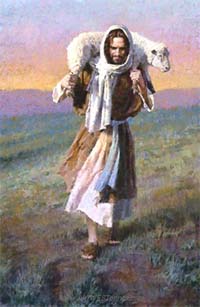
By fifteen I was performing in professional theater. I attended St. Francis High School and of course performed in their productions, which was my fast track to the social scene, as I was invited to all the parties with the upperclassmen. And it all started spiraling out of control pretty quickly. The summer of my freshman year I was jet-skiing with a friend and she accidentally collided with me and snapped my femur in half. That slowed me down for a while, but looking back I think of the shepherd that, when he goes out to to look for his lost sheep, when he finds it, the shepherd breaks its leg and places it over his shoulders so that the sheep will learn to listen to his voice and not stray again.
Isn't that a sweet image? God will break your leg to keep you close. No doubt when the cops come to investigate reports of domestic violence, he'll say he didn't mean to do it and, anyway, you provoked him. As a good little Christian enabler and co-dependent, you'll agree that you made him do it. You know he loves you, right?
I was cast in Stephen Schwarz's musical “Godspell.” For those of you who are unfamiliar with the show, the structure of the musical is that of a series of parables based on the gospels of Mathew and Luke. These parables then are interspersed with modern music set primarily to lyrics based on some scripture and traditional hymns, with Christ's passion portrayed near the end of the musical.
Elizabeth gets to sing the play's big hit song, “Day by Day.”
As I sung this song, as I did my usual escape into the character, I began to really pray. I began to really believe. I began to really love this character of Jesus, this man, this savior, and I was so moved that by the crucifixion scene at the end of the show I was sobbing with genuine adoration and love for him. What's interesting is that I was not looking for him but I could not hide from him, not even on the stage where I thought I was hidden, he knew exactly where to find me. He knew where to find me, and whose love truly awakened my heart.
Elizabeth neglects to tell us how handsome her co-star was, but she lets us know that she followed him into the local “Truck of Love” campus ministry.
After “Godspell” closed and the familiar feeling of emptiness returned, I longed to reconnect with that love I felt while singing to Jesus. So I decided to sign up for an immersion experience with the Truck of Love where I would spend three weeks hosting a summer camp for the Native American children of the Tohono O'odham reservation on the Arizona desert. This would be my longest trip away from home.... Narrowing my suitcase down to one was a heroic effort.

Our mission was to love these children. That's why we left everything behind, because that's all they needed. On this trip I learned a new kind of adventure, a new kind of freedom. It was the adventure of seeking God through service to others and the joyful freedom of poverty.
Excuse me for being rude here, but “the joyful freedom of poverty” is the sort of phrase coined by people who live in comfort. Of course, perhaps I should give more consideration to the fact that she was experiencing the rigor of living out of only one over-stuffed suitcase.
And there was one college student on the trip and every day he would pray the same intention: In gratitude for new beginnings. Those words were the seeds of understanding God's unfailing love, mercy, and grace that were planted deeply in my heart during this time. The desire to simplify my life, to serve others, and to sit with God in silence were just some of the fruits of this beautiful immersion experience.
The seeds planted in Campisi's heart are going to bloom, but we'll consider later whether the garden needs weeding.
Coming back to reality, to my family's luxurious home, fast-paced lifestyle and my usual busy rehearsal schedule was like a toxic shock to my soul. I was repulsed by our wealth and I was angered by our family's lack of spirituality and service that I experienced on the trip. Now being a teenager my perspective was a bit skewed. My parents were not bad people. We went to church and they gave generously of their time and financially and of course they encouraged me to be a good person. But our family was clearly living in the world. It seemed as if our values were set more on success than God.
Now that the scales have fallen from Campisi's eyes, it's the perfect moment for entering a convent. That will allow her to renounce the world, the flesh, and the devil at length and at leisure. She opts to stay in high school instead. A great opportunity is missed. (God will get her for that.)
To continue on this journey for truth and a real relationship with God, I found a new home outside the theater which was my high school's campus ministry. I guess you could say I found another hiding place, but I felt like I could be myself there, too. But there was something very different about campus ministry. The focus was not on self, but on Christ. I started spending my lunch times alone in the chapel praying. I wasn't praying any formal prayers like I had when I was a child. I would just sit and talk with God and many times just be silent. I wanted to feel his presence physically. I wanted him to answer me audibly. I truly believed he was there and slowly I started to believe he was within me.
Seeds. Don't forget the seeds.
I was still performing professionally and at the school, but something happened in my senior year of high school as the applications for college were being mailed and the buzz of the future was humming through the halls when someone asked me what I was going to do next year, I answered, “Well I'm either going to be a nun or I'm going to New York City to be an actress. I'm just not sure yet.” I was really thinking about discerning religious life with the Dominican sisters. And I mentioned it to my parents and it did not go over well. Not that they thought it was a bad thing, but they didn't think I would be happy and they definitely wanted grandchildren. So I fought them for a while until I decided, “Fine, I'll go to New York!”
Campisi's vocation had begun to blossom, but her worldly parents nipped it in the bud. It wasn't, like, any kind of strong vocation. Just a passing fancy. Mommy and Daddy would now shell out the big bucks for a private-school education at Fordham. (So much for “the joyful freedom of poverty”; it will not figure into Campisi's narrative again.)
Yes, I moved to New York City and took one big bite of the Big Apple. I was enrolled at Fordham University's Lincoln Center campus as a theater major, the only university my parents would allow me to attend in the city as it was Catholic—it's actually Jesuit—so at 17 years old I was handed a key to my apartment that I shared with three other freshman girls. And I would have to say that this was also the very beginning of having a conscious awareness of my brokenness, especially in terms of my identity. Being in New York City you are exposed to the best and worst of modern culture, if it exists you can probably find it in several varieties. Being a theater person in New York City played a huge role in this exploration because, as I had mentioned, I would dive into my characters as a form of escape. Now the characters and the plays I was diving into were more complex and darker in subject matter. So within a semester I realized the city was just too much for me to handle. I called my parents around Thanksgiving to deliver the news that I was coming home and they were ecstatic.
Lesson learned. Young people get to make a few mistakes, as long as they learn from them. Right? (Not that Campisi did, as you will see.)
And it seemed like the next day I was on a plane home and enrolled at Santa Clara University. The journey of finding myself which in college is the place where many people do, definitely continued. Coming home offered me little relief to what was going on inside me but there was this sense that there was much more out there for me to discover. I just hadn't found it yet. Again God met me where I was. I started praying in the mission church asking God to reveal himself more clearly to me on this journey. I cried a lot about the memories of the experience I left behind in New York City, but what was born of this suffering was beginning to understand the paradox of the cross. There were some very clear signs God revealed to me while praying. The first was that he was there with me, even in the darkness he never stopped loving me.
It's a good thing that God is omnipresent, given Campisi's tendency to wander about so. At least, though, she's learned that New York City is too rich for her blood. Thus it's puzzling when she runs right back to it.
It was the summer before my senior year of college when I got a phone call from a high school friend who was living in New York City pursuing a career in acting. She'd been cast in a show and she asked me if I wanted to sublet her apartment for the summer and it took me about half a heartbeat to say yes and I was back on a plane to New York City. The real difference in this second round was that I had already prayed and suffered about the first time. I made the conscious choice to dive deeper into that experience. I guess I was young, I was ignorant and still very broken. I was cast in a few weeks in a major production at Goodspeed Opera where I then lived in Connecticut for about four months, coming in and out of the city on my days off. I was in tight living quarters with the cast members of two different productions and made a few fast friends.
She's making friends, gaining experience in the theater, and plumbing the urban experience afforded by New York City. Campisi still feels broken, so it's obviously time to strengthen her faith. Or abandon it.
Knowing that my faith was not on track in terms of my Catholic faith, I decided to take a step back from the Church. I was still longing for God, so I started exploring Buddhism with one of my theater friends. And basically she would chant once or twice a day and invite me to join her. And I would say that longing for God would be numbed during that chanting, but I always felt empty afterwards.

I was waiting for enough time chanting to experience the peace. I even went with my friend to the Buddhist temple in New York City and chanted with a large group of Buddhists and after about fifteen minutes I thought about Jesus. I saw his face in my mind. I imagined myself looking into his beautiful merciful eyes and I thought, “I love you.” I walked out with my friend and politely excused myself for the evening. I knew that wasn't what I was created for.
I'm curious whether Campisi's mental image of Jesus matches the young singer from “Godspell,” but she neglects to enlighten us. In any case, God was clearly putting the screws to her again. Message received! Or not.
Unfortunately, I didn't yet come back to the Catholic Church. I was still wrestling and severing the ties with an unhealthy relationship I had also been involved with. But when the show ended, I headed back home to California with my mind set on returning very soon.

It didn't take long for my parents to figure out that something had gone wrong while I was away. My mom said she didn't recognize me and thought I had changed so much. I didn't think that I had changed that much, but then I had a moment when I was in my bedroom alone and I was miserable, missing New York and the friends I had met there, and I caught a glance of myself in the mirror and I thought “Wow, who are you?” And the best image I can describe of that was shame. Finally I realized that I had sinned because I chose to turn away from God, to follow my will, not his. And it was like the fog lifted from my eyes and I realized what am I doing? I love my God. He loves me. How could I do this? And my life turned around at that moment of repentance.
Now she plunges into several rounds of going to confession and getting counseling from priests. Campisi gets a mixed message from the priests and they do not heal her brokenness, but neither do they break her further, so she's lucky.
Well, the cross was back up on my shoulders and I was moving forward. I returned to mass with my parents on Sundays and I would attend weekday mass at the mission church as I was wrapping up my final quarters at the university. Although my parents had planned to purchase a place for me in New York to pursue theater after graduation, the deal suddenly fell through. I can understand God would want me back in a relationship with him and back with the Church, but I couldn't understand why he wouldn't want me to pursue my dream, to pursue a career in theater. After all, he gave me those gifts, wasn't it my responsibility to use them? Well, man plans, God laughs.
God sure is a jolly joker, but at least it's clear to everyone that Campisi should stop pining for a career on Broadway. Her God is not at all sympathetic to the idea. He even used his omnipotence to make a New York City condo purchase fall through for her parents. What can one do in the face of such power but tremble and obey?
One night I remember literally crying out to God and saying, “That's it! I can't do this life thing alone. You just need to send me someone you want me to be with if you want me to be married. That's it!”
God likes it when you talk mean to him.
Well, my prayer was answered. To my surprise, I met my future husband that night at a party I didn't want to go to. I showed up and when I was about to leave, he showed up. He asked me to dance and didn't leave me alone until eight months later we were engaged. I did pray for it, but I didn't expect it would happen so quickly. I wasn't ready. But my husband Greg definitely was a gift from God. The only way I can tangibly explain what happened when we met was I experienced a deep, God-given peace.

Greg was a man of faith. In fact, the first time I rode in his truck I noticed a rosary hanging from his door handle and a St. Joseph prayer-card on his dash. He was nothing I had ever known I was looking for, or a dream I never realized until we met. But I can truly say that the day we were married, when I offered myself to Greg and to God through the sacrament of marriage, I knew God's promises were true, that all things are possible.
Now that she has love and a “deep, God-given peace,” it's time for living happily ever after. Unfortunately, Campisi declines to feel unbroken. She takes off with her family on a European tour that includes a stop at Lourdes.
We also visited Lourdes where I was able to ask God in a special way to heal me of the wounds and brokenness of my past.
She asked, but it's evident that she did not receive. She attended a papal audience in Rome and read John Paul II's “Letter to Artists,” in which the playwright-pope exhorted artists to reflect the beauty of God and his creation. Naturally, this put Campisi back on the road to New York City.
And it was on this trip that I would say I fell in love with my soon-to-be husband Greg because I was finally beginning to heal and love myself and my faith and understand that God was giving me everything I could ever dream of.

I was still pursuing professional theater and very much on the road to a career in theater.
A San Jose production of “The Children of Eden” brought its author out to the West Coast. It was Stephen Schwartz, the composer of “Godspell.” Campisi says he was struck by her performance.
To my surprise, Stephen asked me if I would be interested in a role in the new musical he was writing—called “Wicked.” Of course, I thought this would be a dream come true and I said yes. I flew back to New York for the final Broadway workshop. And it just seemed like this was the door that was waiting to be opened for me. I flew out a second time to meet with a few other casting directors who were interested in me for other productions on Broadway, but Stephen sat me down for a meeting and asked me not to consider any other show. He pulled out a paper with a typed cast list and showed me my name next to the role Nessarose. I floated back to San Jose and shared the news with Greg, but I could sense the reality of moving to New York was not in his plans, so I began to pray that this door would open only if it was his will, only if it was meant to be for our happiness as husband and wife and our future together.

Well, my prayer was answered. A few months passed and I was waiting for the call to receive my final offer for the role. I had seen my name printed on the cast list. And to my surprise again, Stephen called me to tell me that the director decided to cast someone else in the role. He was very sorry and even a bit confused as we both thought that this was a sure thing. I began to understand what God was telling me.
The road was long and hard, but its conclusion was unambiguous. Surely Campisi would now understand God's message, right? If you think that, you obviously haven't been paying attention.
I fought it out with God a while longer. I kept getting calls from casting directors and flying back to New York to audition. I still didn't get it when the flight I took sometimes three or four times a week was United Flight 93 that would crash into the World Trade Center on September 11, but by the grace of God I had decided to hold off on my auditions for a few weeks when this happened.
We already know that Campisi wanders in a God-befuddled fog, but this is a mystery that passes all understanding. How could she possibly get this wrong? Flight 93 crashed in Pennsylvania after its passengers attacked the hijackers. It never got anywhere near the World Trade Center. In fact, its likeliest target was the Capitol building in D.C. Again, I ask how Campisi can get this wrong. Didn't she pay attention to what happened to the flight she said she used to take multiple times a week?
I gave Broadway one last shot with “Fiddler on the Roof.” Again I was in the final round of casting for the role of Hodel. This time I prayed nonstop the entire time I was there. I was finally ready to give it over to God. I just prayed that he would shine through me at this final audition and touch the hearts of the directors and writers. I let go and let God. I walked out and had great peace. My mom was with me and I had asked her to pray a rosary for God's will to be done while I was in the audition. And then we took a cab to a nearby Catholic Church. I remember saying to God, “Okay, I know this is it. I'm not chasing this dream anymore. This is your chance to have me to follow my dream, or the door will close today and I will never look back.”

My cell phone rang. It was my agent. She said these exact words: “Elizabeth, they said they loved you. You had the best voice they heard and performance of this song. And they don't know why, but they just don't think it's going to work out.”
Surely no agent has ever spoken such words to a client without their being literally and exactly true.
I got off the phone and tears filled my eyes for just a second, and then a huge burden was lifted from my shoulders. I just gave it back to God and walked away.
That part about the lifted burden? Campisi doesn't really mean it. You'll see.
Back home I went and began to work through this door closing in my life. It was a significant death to self moment and it hurt like hell. This began a dark night of the soul experience for me and of course my husband, too. Greg and I had to come face to face with the reality that we had spent a lot of time apart during the first few years of our marriage and so we had makeup time to do in terms of talking and understanding one another and the future we were trying to build from that moment forward.
Had you forgotten about Greg? Me, too. Now that she noticed she had a husband, Campisi went into counseling with him.
I don't remember the exact meeting, but there was a priest that gave Greg and I a book on marriage to help us as we began this process. It was called Marriage: A Path to Sanctity. And I confess, I never read it. It looked way too intense for me at that time! My eyes crossed just looking at the cover. But I kept it within sight, somewhere in my office or bedroom, I don't remember. But the title resonated with me in a way that I knew was truth, that there was a greater purpose in my marriage for my soul that I had yet to understand.
I've heard about judging a book by its cover, but this is the first I've heard about “resonating” with its title instead of its content. Have you noticed that Campisi is no damned good at communications? She recounts various attacks and death threats supposedly coming from her beloved God, but never learns a lesson from them. She receives a book during marriage counseling but doesn't do more than “keep it within sight.” It's an awesome talent she has, but not one she recognizes.
In terms of my career, God had already opened a window for me to escape into, even before I was ready to fully accept it. Remember I mentioned that I decided to take a break from auditioning in New York and it was when Flight 93, the flight I would take each week, went down at the World Trade Center. Well, during that break of only a few weeks, I decided that I needed to take a part-time job that would help pay for the expenses of travel and classes as I continued my theater career. Well, where did I go? I'm so predictable! To that familiar hiding place I had found comfort in high school. I was hired as the young-adult minister at a campus ministry at San Jose State working for a Dominican nun. During my first few days working at campus ministry, hit the tragedy of September 11. All we could do that week was just stare at the television screen and watch the events unfold. And the Bible I have here on my desk now, Sr. Marcia gave me as a welcome gift. When I opened the front cover of the Bible at that time, I wrote, President Bush's address, World Trade Center attack, September 11, 2001. Because as I watched the president give his address from the television at campus ministry, I had this new Bible in my hands. The first and only prayer inscribed on the left inside cover was Psalm 23:

The Lord is my shepherd;
there is nothing I lack.

In green pastures you let me graze;
to safe waters you lead me;
you restore my strength.

You guide me along the right path
for the sake of your name.

Even when I walk through a dark valley,
I fear no harm for you are at my side;
your rod and staff give me courage.

And if you remember, those are the exact words the president gave in his address that day.
No, I beg to differ again. Elizabeth, you're reading the psalm as rendered in the New American Bible, the authorized Catholic translation from which the Church takes its readings for mass services. The president's speech actually cited only the “shadow of the valley of death” line of the King James Version translation, which is the more readily recognized rendition. Were you paying any attention at all? I guess not.
As you can imagine this prayer took on a special meaning for me in my life. So here I am, hired as a young adult minister at campus ministry, and although I attended Catholic schools and considered myself as someone with a deep devotion to God and my faith, I knew nothing. Absolutely nothing about my faith. How was I supposed to lead as a young minister for these students? I wasn't. This experience was God's way of picking up his lost sheep again and placing it around his neck. He didn't break my leg this time to keep him close to him. Since this was my job, he knew I'd keep coming back, as least for a while.
Let us pause to praise the beneficent God who is no longer breaking legs. though he did unleash a bunch of terrorists on the East Coast to send Campisi a message.

Campisi continued her walk with the Lord on sound legs, but with a troubled heart. She immersed herself in Bible study, but began to be unsatisfied with campus ministry. She took a bizarre detour into professional fundraising, working for Stanford University. She was employed by an office that organized major campus conferences, including some that featured world-famous speakers like Greenspan and Bernanke. It was during this phase that she learned that Jesus was “very much an economist.” While this new insight would have been fun to explore, Campisi instead recounts that God had other plans for her. Indeed, the Lord of the universe decided it was time to lovingly smite her again.
God was not letting me go. Like the theater world and New York City, God closed the door on this chapter very quickly. I unexpectedly developed an illness and never before had my health failed me, but it was so serious that I had to leave Stanford. Honestly, looking back as I recovered a few months later and I had a chance to return to my position, I realized that God was calling me back to him. You may be wondering my husband in all this, well, this is where the real work began with us. It took my health to fail to bring me totally to my knees and surrender completely. It was another cross that brought me back to the loving arms of Christ and the loving arms of my husband.
At this point, there is no need to belabor the observation that Campisi interprets every accident, mishap, and illness as a loving reproof from God, who in Campisi's world is an exceedingly abusive lover.
Out of this state of recovery, Greg and I started to engage more actively in our faith together out of a need to connect and turn this page together. We attended mass on Sundays and first Fridays together and we encouraged each other to pray the rosary daily. Finally, on our four-year wedding anniversary, it seemed things were finally turning around. Greg and I renewed our vows privately, at the Shrine of Our Lady of Peace Church in Santa Clara, California. It was during a first Friday mass there at Our Lady of Peace a few months later that during the consecration of the eucharist I was overwhelmed with a feeling in my womb. It was so powerful that it frightened me, so I got up and I walked to the back of the church and I sensed a quiet voice within me saying, “Do not be afraid.” A few weeks later I gook a pregnancy test and it was positive.
I admit that I laughed aloud when I heard this segment for the first time. Campisi's version of the occurrence stretches credulity beyond the snapping point. She tells us she experienced a miraculous manifestation in her womb. She then waits “a few weeks” before taking the pregnancy test that confirmed she was with child. Weeks?! A credible narration would have related that she drove immediately to a drugstore and picked up a test kit at the earliest possible moment, even before the afterglow faded.

But no, she waited “a few weeks.”

And she has no idea how ridiculous her story sounds. She continues blithely to recount the birth of her first son, following it with a corker of an incoherent sentence about her second son:
And, to our surprise, Thomas Peyton was conceived and born in September of 2007.
That's a good trick, worthy of its own chapter in the Bible. I understand their surprise.

The good news, of course, is that she and Greg can now settle down to a proper Catholic family life with their two sons. All of the trauma of the past has been resolved and Campisi is finally on the path to healing and can turn away from the temptations of this world. She's learned her lesson.

Ha! Are you kidding?
It was in the silence of motherhood that I would open my heart again to trust in God's new plan for my life. Maybe I could sing again. Maybe I could use my gifts for him in some way.
Oh. My. God.

After telling us that God kept bludgeoning her into submission after numerous attempts to secure a career in the performing arts, she pops up one more time with the thought that maybe she could still be a singer. Despite what she says, she doesn't believe her own interpretation of the events in her life.

Campisi wrapped up her story with an account of her initiation into Catholic Radio and the plum assignment of hosting “Why I'm Catholic.” The program, however, did not catch on and she was using this final episode to share her own story of “brokenness” and God's schoolyard bully approach to leading her back to the Church. She excitedly shared the news that she had recorded her first album and would debut a song from it at the end of the show.

I admit that I turned off the radio at that point. I've heard that last show a number of time while transcribing excerpts, but I have yet to make it all the way through the inspirationally saccharin song she presented as the final program's finale.

Besides, I was afraid God would break her leg or something during the song and it would all end with Elizabeth croaking out, “Thank you, Jesus, for loving me so much.”

Read more...

Another non-miracle miracle

Get well, Allen Wright

I hope Allen Wright beats the odds and experiences a full recovery from the hit-and-run accident that put him in the hospital on Sunday, March 13. He's the teenager who received some previous publicity for his invention of “A Note to God,” an iPhone application that delivers messages to ... well, no one. However, users of the application get to enjoy sharing their prayers anonymously with other believers (and only God will know who they are). It hardly seems necessary to acquire an iPhone app to send God little notes, but what-the-hey, it's a digital age.

Anyway, today's headlines report that Allen is out of the eight-day coma that followed the accident and he is responding—apparently with some comprehension—to family members and medical personnel. It's a very encouraging sign.

But it's not a miracle, despite what some devout people want to believe. Here are some comments posted by believers on the website of the Sacramento Bee:
Miracles do happen...Awesome....


God always has a way of turning a negative situation into a positive one!


My first thought is, "God has answered your letter Allen".


It's a miracle from god that he brought Mr. Wright out of his coma.


to God be the glory! Yes, there is power in prayer. And I guarantee, that every one of you reading this post, would begin praying when ANY family or friend becomes ill or experiences an accident.


That news gave me the chills. What an awesome God we have.


Divine Intervention.
Did the “awesome God” who allowed Allen to wander into the path of a speeding car decide to tidy up his own mess and divinely intervene to restore his victim to consciousness? Did he repent of his plan to take out the boy who was spamming him? The Bee tells a slightly different story. The doctors at Mercy San Juan Medical Center injected Allen with drugs to deepen his trauma-induced coma. It was an attempt to protect the patient by reducing brain swelling, giving him time to heal without suffering the additional trauma that brain-swelling would induce. After one week, the doctors withdrew the sedatives. Within hours, Allen opened his eyes.

Not exactly a miracle, but still an encouraging sign. He then demonstrated that he could respond to questions by sticking out his tongue. Quoted in the Bee, neurologist Kavian Shahi said, “One of the most important things we like to see from patients is whether they follow commands. It indicates they can understand language and react to language. It takes a lot of brain power to do that.”

The Bee reporter asked Dr. Shahi if Wright's awakening was aided by the prayers offered up on his behalf. The doctor gave a discreet response:
“Sometimes I think it does. Sometimes I think it doesn't,” he said. “I don't actively encourage it. But in my opinion, it never hurts to pray.”

No, it never hurts to pray. I encourage all believers to do so regularly. It keeps them out of trouble and out of our way. Praying for Allen isn't going to do him any good, but it might calm the nerves of those who pray. I guess that's good. Sort of.

Allen's brain, which probably still thinks there is a God, may be on the mend. Let's hope so. But I won't bother to pray.


Allen Wright's recovery, whether complete or partial, is certain to be difficult and probably lengthy and expensive. A fund has been set up: Allen Wright's Foundation for a Better Life, Wells Fargo, 6047 Sunrise Boulevard, Citrus Heights, CA 95610.

Read more...

Sexy Nude Celebrity Hot Female Celebrity